Dwelling Spaces

Thursday, 3 January 2019

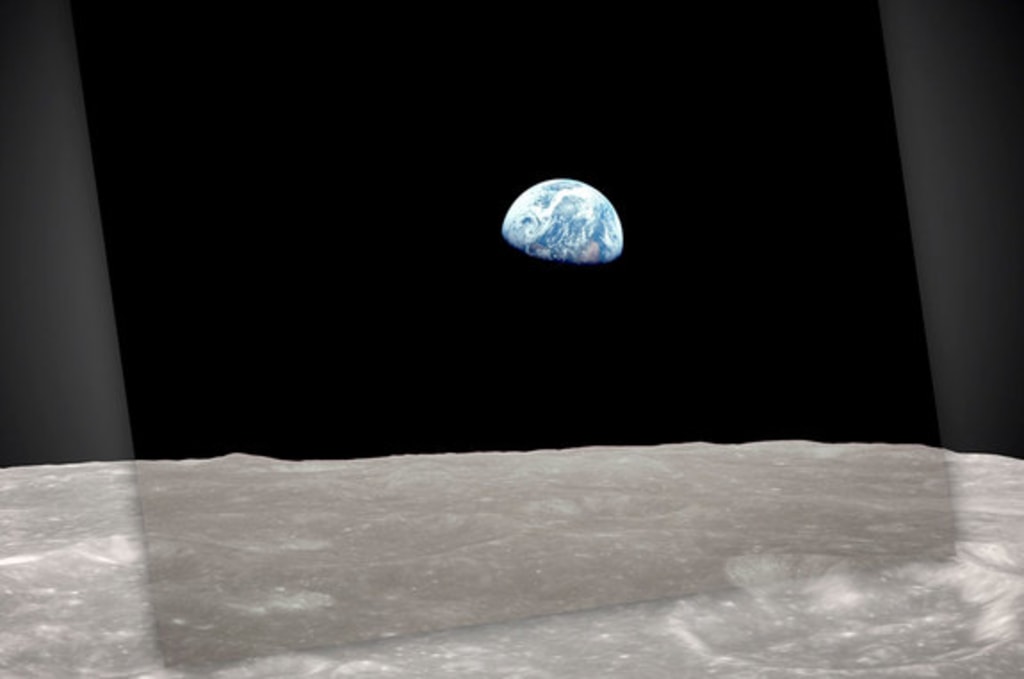
Christmas Eve - Earthrise

Image result for earthrise photo apollo 8
Photo credit: Apollo 8 astronauts with NASA Lunar Reconnaissance Orbiter data


Fifty years ago tonight, Christmas Eve 1968, the crew of Apollo 8 did what no human beings had done before, in their tiny space craft they orbited the moon, seeing the far side of the moon for the first time, and then they saw the earth rise over the horizon. This is the photo they took. Thanks to space exploration we have become used to seeing the earth from space, but just 50 years ago this sight of the fragile earth rising made people catch their breath and wonder at creation.

In the last of their 10 orbits of the moon the crew of Apollo 8 did a live television broadcast to earth watched by over 1 billion people. I find it extraordinary and moving to watch this (link below) and hear the astronauts ask for God’s blessing on all on earth. There is particular power in these words being spoken on Christmas Eve as we remember that God’s way of blessing the earth was to be born a baby in Bethlehem. In chapter 3 of John’s Gospel we learn that it was because of God’s great love for us that Jesus came to live amongst us, to die for us and to show, by rising from the dead, that even death cannot separate us from the love of God. Borman, Lovell and Anders (the three crew of Apollo 8) speaking much later about the mission spoke about how they had tried to work out what to say on their TV broadcast with little success when one of their friends wives suggested starting at the beginning. And so they read out the first 10 verses of Genesis 1 - the first 10 verses of the Bible - a reading that became part of space history. 

The Bible starts with these words: in the beginning - God. In the beginning - God. Before anything was made that has been made, Christians believe that God was. In fact the very name of God - Yahweh - is I am who I am, the one who is without beginning and end. But God doesn't just be, God speaks and acts. And tonight's readings from Hebrews (1.1-4) and Johns Gospel (1.1-14) tell us more about God's speaking and actions. In the beginning - was the Word. John as he writes is taking us back to before the creation, back to what is recorded in Genesis 1.  To understand where we've come from we go back to the beginning.  In the beginning was the word and the word was with God and the word was God. He was with God in the beginning. Through him all things were made and without him nothing was made. And the word became flesh and made his dwelling among us - literally pitched his tent.  

This is an extraordinary claim, that God who spoke that blue Jewel we call earth, that we call home, into existence would give all that up to be born a fragile baby on a fragile planet. Why should we believe something so incredible?

I know that believing this is part of my job as a vicar (!) but the longer I have thought about this story the more convinced I am that this is the only story that makes sense of the world we see around us.

There are only two options about our existence. Everything came about by chance or everything was created by a higher power. Now of course everything is possible, but for me the probability of chance producing our beautiful planet with the right conditions for life seem so small to be unrealistic. Even if I accepted that it is possible for the ecosystem to bring forth the plants, animals and intelligent humans, I would have to believe in the survival of the fittest, and if I believe that then it is a mystery why we would ever be kind, or would choose to love and to set ourselves aside for the sake of others.  Because when we do that, it's not survival of the fittest, it is letting someone else take advantage of you. But the world I see in all its brokenness is a world where people are good and kind, where each of us long to be loved and accepted. Where we believe in right and wrong. And these are not pointless, they are the things that give our lives meaning. 

And that is partly why I believe a higher power created everything, and I have come to believe that higher power is God the Trinity, Father, Son and Holy Spirit, and that tonight we remember the extraordinary moment in the history of our planet when God was born as a baby, in a stable in an insignificant town in an oppressed nation. 

When I saw the readings for tonight I smiled because at the very moment we remember that Jesus arrived in the blood and mess of human birth in the dirt of a dark stable, we have these astonishing readings from John and the author of Hebrews as they try to do what no human words can do – try to paint a picture of what it means that this same baby is God.

The Hebrews passage where we have four verses is actually one sentence in Greek. Like the author doesn’t want to pause with the excitement of who Jesus is!  The author tells us that God has spoken throughout history in the words of the prophets, but now in Jesus we hear God direct because when we see Jesus we see God.  Jesus radiates God’s own glory, is the exact imprint of God’s nature, and he upholds the universe by the words He speaks.  When we see the earth rise above the surface of the moon, that is the work of Jesus Christ, and when we remember that there are 7 billion of us living on that tiny blue planet, all equally loved by God, it is mind blowing.

And yet, here we are at a stable in Bethlehem remembering that this is the promise God has made – to be God with us.  With us in our weakness, vulnerabilities, in the mess of life and death.  When we see earth as those astronauts did we realise how fragile we are in comparison to God, and how easy it would be for God to crush us or control us.  But the story of Christmas reveals who God really is, God’s offer of love comes in a way that forces no-one to believe and offers everyone the chance to turn away.  The reading from John’s gospel says although the world was made through him, the world did not, does not, know him. 

So this is the story of Christmas, it's a love story. God loves you and created you with purpose. God offers all who believe the opportunity to become children of God. This is an unconditional love that says: I love you, will you love me?

I hope your answer today will be yes.  


If you want to listen to the Apollo 8 Christmas Eve broadcast of the Genesis 1 reading here is a link: https://www.youtube.com/watch?v=6vvNxhlP1jA


Friday, 7 December 2018

How do you sum up a life?


Yesterday my Grandma would have been 98.  But she died before she got there, and today we held her funeral.  As I was driving home the day after she died, my mind full of rich and abiding memories of someone I dearly loved and who dearly loved me, I kept thinking 'How do you sum up a life?'. And so I wrote a poem, and that is my tribute to her today.  Love you Grandma.


How do you sum up a life?
When the end was close, and words became noise
It was in the look of love
Resting with my face a breath from yours
Hands held tight
Eyes locked tighter still in a soul’s embrace
As I stroked your hair, I thought of your mother
Ninety-seven - nearly ninety-eight - years ago
Stroking the head of her precious first born
No words then to be spoken
Just a look of love to be shared.

How do you sum up a life?
You bookend it with looks of love.

How do you sum up a life?
You weave it through with a golden thread
Of love and care and kindness
And so many people
Those nursed, those gathered up and taken in, those family, those friends,
              those whose presence reappeared in a glance at that ornament or that cup
Things were precious because of the people that shared them.

How do you sum up a life?
With the humble exceeding of expectations 
     "Girls don't need an education to be a maid"
     But in service you grew character 
     With war came opportunity 
     With marriage came partnership
And you rose with dignity, amazed that you could eat from a table with white cloth and flowers,
      that you could travel the world
And so, so proud of your son, your granddaughters, your great-grandchildren,
      forgetting that you were the one that created us...

How do you sum up a life?
With times of loss
Different futures snatched away
Yet somewhere deep drawing from a well of courage
To reorient life again and again.

How do you sum up a life?
With simple joy and contentment
The smell of a rose, a handkerchief, a cream cake, a 'special' breakfast
Pleasure in the stories of those you love
Feeding those you love on plates that were never quite big enough
The sunshine on trees, the children playing, the little treats
A swing round the dance floor, secret delight in the words that weren't quite right
"Shall we play a VD now....?"

How do you sum up a life?
"A special lady" seems not enough
So I'll leave you with that look of love.


Friday, 22 June 2018

Seed - a poem


Seed


   Dancing in the gentle breath
   Catching light
   But so fine
   Casting but a glimmer of a shadow


Seed


   Holder of new life
   A story waiting to be told
   Coiled up
   An aching of potential


Seed


   Plunging to the ground
   Breaking open in darkness
   Stretching


Seed


Photo credit: Jo Pestell

Tuesday, 10 April 2018

hallelujah


Hallelujah or Alleluia...it's that time of year when Christians say it a lot! It means 'praise ye the Lord' or 'Dudes! Let's praise God!'.  We say it to encourage one another to recognise how awesome God is.  It feels a particularly powerful word just after Easter in the Church of England because we have tried to avoid saying it in Lent during the six weeks that run up to Easter.  Why?  Because we are waiting for Jesus to be fully revealed as a different sort of Lord and King.  A King who was enthroned on a cross, killed by those he chose to forgive as he showed that through him - Jesus - nothing can separate us from the love of God.


Nothing can separate us from the love of God in Christ Jesus our Lord (Romans 8.38-9).


After Easter I went off to Spring Harvest with my church.  Spring Harvest is a big Christian conference with thousands of people gathered together to study the bible, pray and sing to God, and learn more about how to live the Christian life.  Whilst I was there we had the privilege to hear from someone who had spent many years in prison in North Korea for being a Christian.  It was a distressing and powerful story to hear which involved the killing of family members, brutal torture, hard labour, and unbearable living conditions.  In this place of sleeping on cold concrete, rat and insect infected, piled up in small rooms with people who died in the night and whose bodies were often not removed for days...in this place the whispered gatherings of a handful of people kept faith and hope alive.


As Christian believers passed each other they would whisper to each other 'hallelujah'.  What an extraordinary word to whisper into the face of unbelievable oppression. Hallelujah.  What is it about Jesus that draws praise from the lips of someone in the midst of such intense suffering?  Hallelujah.  I think it is this truth that there is no place to which God is not prepared to go to with you so that it can be healed and redeemed.  And in that truth is hope. 


Leonard Cohen sings of hallelujahs that are cold, hallelujahs that are broken, hallelujahs that are holy.  Choosing to praise the Lord does not always come from a place of joy and peace. Sometimes it may not even come from a place of hope.  But the hallelujah that emerges as a trailing whisper from the very end of ourselves will always connect us to the One who knows our end from our beginning, who holds our lives together. 


Wednesday, 21 March 2018

Touch


Another thing that struck me in Tanzania was the higher level of physical contact people have with each other.  It was fairly common to see men holding hands with each other, especially when talking one-to-one.  At the end of church services there was a great snake of people as you would shake hands exiting the building and then join the end of the line so everyone ended up shaking everyone else's hand! One of the challenges for me as quite a tactile single person is the lack of human touch I experience day-to-day, and in particular with men.  Commentators are beginning to talk more about the general absence of touch in our society (see for example this recent article from The Guardian) and the implications for our general well-being.  It is lovely holding hands with children as they skip along, or being able to hold someone's hand to offer comfort or reassurance.  I have a few friends who I might hold hands with from time to time, but none of them are men, and I have to admit that I miss that sort of contact.  So it was really great to spend time in Tanzania with lots of married men who thought it perfectly normal to hold my hand when talking!


Given the issues that arise for people in the absence of regular touch, and yet the understandable withdrawal from physical contact out of fear of it being misunderstood or abused, how should we navigate this?  I don't see any obvious easy answer, but I am sure that part of the answer must be reclaiming touch from always having sexual overtones.  When I hold hands with people, it is a sign of sharing life, of being focused in my conversation and attention with that person.  It is not a sign that I want to jump into bed with them.  We don't assume this when we see people of different generations holding hands, but I'm not sure this is our default assumption for people of the same generation holding hands.  And so it takes a lot to be secure enough in your own identity not to be undermined by other people's assumptions about you.  I have been single now for over 20 years, and confident in that as my calling, but I am still susceptible to modifying my behaviour to avoid further speculation from people about me.  If I hold hands with a female friend then perhaps people think I am a lesbian.  If I hold hands with a male friend, I am either being too forward or threatening their marriage.  I'm sure I have probably had the same horrible thoughts about other people, but what I want to do is train myself to think that this is a great sign of friendship first and foremost.  Is that too naïve?  What do you think?


Sunday, 18 March 2018

Tension


At the CNC morning service today we were thinking about tension in our faith lives. The Christian faith is full of things we hold in tension: Is Jesus fully human or fully divine? Well...YES! Is the kingdom of God now or not yet? Umm...YES again!  Is God an intimate friend or unapproachably holy? YES!   These and many other things seem like paradoxes, like both can't be true, but they are both true and trying to hold them together can cause us tension.  However, they are also things that we are not necessarily meant to resolve, because they are part of the mystery of God. As created beings we can only know our Creator through revelation, and as we sit in tension, wrestling with questions this should draw us deeper into a relationship with God.


During the service we read Luke 19.29-41.  It is the story of Jesus' triumphal entry to Jerusalem on Palm Sunday, and although it is a week too soon (!) I wanted to reflect on the story this week.  In these verses we see Jesus proclaimed as king, the one who is coming in the name of the Lord.  The crowds of pilgrims thronging the road waving palm branches seem to finally have realised who Jesus is.  And yet in the midst of the joy and celebration we see Jesus looking over the city laid out beneath him and weeping.  Jesus knows that the people will either turn against him, or be too scared, or unable, to stand with him.  Celebration and profound loss are held together.  It is right that the people should acknowledge Jesus as King, but they are blind, as we often are, to the sort of king Jesus is. When I was in Tanzania, I was with a pastor whose first born babies, twins, had been born the night before.  He said simply to me: "one died and one lived".  We somehow held that loss and joy together before God, trusting that God was present and knew the answers to all our questions.


Sometimes our different perspective leads to a different response to situations.  At the moment at CNC we are in a time of 'stripped back' worship, with no band and plenty of silence with opportunity for people to lead songs or prayers.  This is not a comfortable place for everyone, some are loving it, some are finding it more of a challenge, but together we are holding that tension and seeing where we can see God at work in our midst.


So, some things to ponder this week:
  • As you read Luke 19.29-41, how do you feel about Jesus?  Do you want to welcome him as king?  Do you feel a sense of loss because you can't recognise him as king?
  • Where are the head and heart tensions for you with your faith at the moment? Take time if you can to ask God to show you more of who God is through the tension. 

Wednesday, 14 March 2018

Faces

I was so engaged in Tanzania with the smiles and openness of people’s faces. It was so lovely to see the joy and laughter pouring out of people, and on the flip side to see when people were bored, fed-up or sad.  The contrast to the UK where people seem much more 'closed' was striking.  I wonder if this openness is partly due to the absence at the moment of cameras, and to a degree mirrors...  Following the #liedentity conference I was thinking about our obsession in the UK with our image.  Studies, for example, show that people take an average of 7 minutes to post a selfie, this involves selecting one image from a number of photos, applying filters and choosing good hashtags. I wonder how much this attention to how we look impacts on how we control our facial expressions?

People have often told me I smile a lot.  Even getting off the aeroplane this trip one of the air hostesses stopped me and said 'thank you for smiling - every time I saw you you were smiling'.  Is it really that unusual?!

Having seen the faces of people in Tanzania, I cannot really remember seeing people looking anxious. There were certainly plenty of things to potentially be worried about there with the level of poverty and limited infrastructure. The existence was much more day to day and felt to me much more outside personal control. There was a big contrast with the situations of relative affluence around me in the UK where we believe to an extent we can provide for ourselves and control our lives.  I wonder how much this illusion of control is anxiety inducing?  When Jesus talks in Matthew 6.24-35 about not being anxious food or clothes but instead seeking first the kingdom of God, the passage ends: therefore do not be anxious about tomorrow, for tomorrow will be anxious for itself. Each day has enough trouble of its own.
We in the UK and those in Tanzania all have plenty of troubles to face, some similar and some different, but we are all meant to be living lives in partnership with God and each other.  To do this well we have to be vulnerable, and to be vulnerable is to shake off the desire to control both our image and our independence.  A carefully controlled image will only ever separate us from others, as it becomes harder to maintain integrity between our inner life and what we allow others to see.